In 2026, your organization is no longer defined solely by the controls within your own environment but rather is defined by its collective security posture. That includes every employee, vendor, supplier, SaaS provider, contractor, and AI-powered service that you engage with, and attackers understand this reality. Rather than targeting heavily defended organizations directly, many now focus on exploiting weaknesses within the broader supply chain. One compromised account or misconfigured cloud environment can provide an attacker with an entry point into dozens or even thousands of downstream organizations.
Third-party risk management (TPRM) is no longer just a compliance checkbox. It’s a strategic imperative. A single vulnerability in a minor vendor can lead to catastrophic data breaches, financial damage, and irreparable reputational damage. Risk management is only becoming more complex with advances in Agentic AI. To assist, we’ve put together a comprehensive playbook with an actionable framework that will help you build a mature, scalable, and resilient TPRM program.
- Establish a Rigorous Governance and Control Set
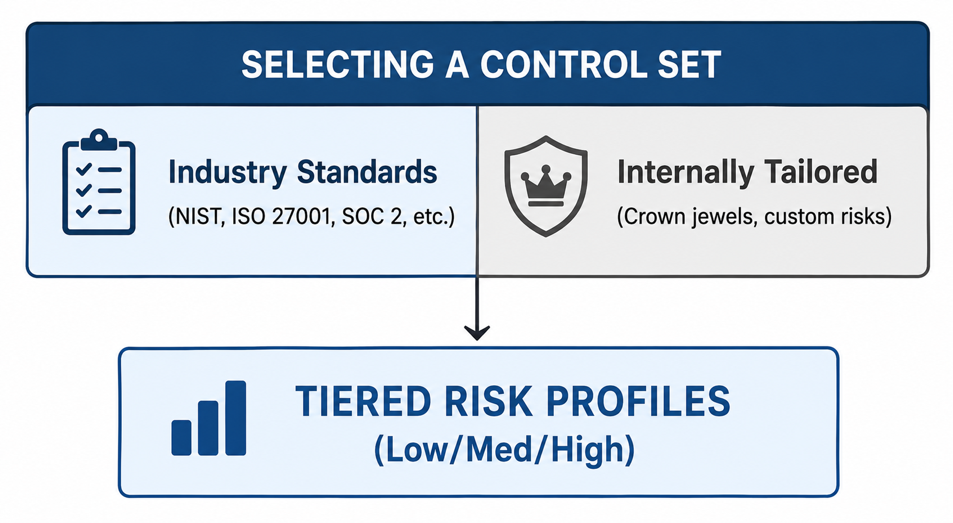
Before you can assess your vendors, you first need to figure out what benchmarks they need to meet. This is critical, because your control set is the foundation of your entire TPRM program. It ensures consistency, objectivity, and alignment with your organization’s risk tolerance. To get a better understanding of how to select a control set, note the chart below.
Choosing the Right Framework
Thankfully, there are already established, globally recognized industry standards to build your core control set that you can start with. Your choice of framework largely depends on your industry and regulatory landscape.
ISO/IEC 27001 & 27002: Ideal for organizations operating globally, providing an internationally recognized framework for information security management systems (ISMS).
NIST SP 800-161 (Cybersecurity Supply Chain Risk Management): The gold standard for federal agencies and organizations looking for a deeply robust, comprehensive approach to supply chain security.
Shared Assessments Program (SIG): The Standardized Information Gathering (SIG) questionnaire is highly favored by TPRM professionals for its pre-built, industry-vetted question sets.
SOC 2 Type II: Particularly relevant for evaluating SaaS and cloud providers, with a primary focus on security, availability, processing integrity, confidentiality, and privacy.
Customizing vs. Standardizing
While standard frameworks provide you with a strong baseline, a mature TPRM program tailors these controls to its specific business case. Consider your “crown jewels”. These are your more critical and operational assets; the assets, data, systems, and business processes that would cause the greatest financial, operational, legal, or reputational damage if compromised. Once you define those assets, you can proceed with aligning vendor assessments and control requirements to the specific risks that are associated with those assets. For example, if you are a healthcare organization that handles Protected Health Information (PHI), you must prioritize controls related to HIPPA and HITECH compliance. Vendors that handle patient information will likely require further scrutiny around encryption, access management, audit logging, data retention, breach notification procedures, and subcontractor oversight.
Healthcare is not the only industry that may require additional oversight. Financial institutions must place significant emphasis on regulatory requirements, fraud prevention controls, data privacy protections, business continuity capabilities, and third-party concentration due to strict oversight from banking regulators. If you are a technology company, your organization should prioritize intellectual property. Protection, secure software development practices, cloud security controls, source code management, and software supply chain integrity.
This risk-based approach allows organizations to move beyond a one-size-fits-all assessment model. Rather than subjecting every vendor to the same type of and level of review, vendors can be categorized into risk tiers based on unique factors such as:
- Access to sensitive data
- Connectivity to internal networks
- Dependency on the vendor’s services
- Geographic or geopolitical considerations
- Impact on critical business operations
- Regulatory exposure
- Volume of client information handled
The resulting tiered framework will look something like the graphic above, classifying vendors as low, medium, or high risk, with each tier mapped to a corresponding set of control requirements and assessment rigor. While a low-risk vendor may only require a basic security questionnaire, a high-risk vendor that supports critical business functions may undergo extensive due diligence, evidence reviews, penetration testing validation, continuous monitoring, and executive-level risk acceptance processes. The goal of TPRM is not simply to demonstrate compliance with a framework. Rather, it is to ensure that third-party controls are aligned with what matters most to your business. By combining industry standards with controls tailored to protect your organization’s crown jewels, the result will be a TPRM program that is both compliant, and genuinely effective at reducing real-world risk. With that, now we will go a step deeper and look past relying solely on questionnaires for your data gathering efforts.
- Information Gathering Mechanisms: Looking Beyond the Questionnaire
Questionnaires are an exceptional tool to gain large quantities of information at once from a vendor. However, gathering data from third parties requires a balance between depth of insight and operational efficiency. Relying entirely on one method creates blind spots in your data. To combat this, a hybrid data-gathering mechanism would result in your organization having a robust TPRM program.
Static Questionnaires
Questionnaires remain a staple of TPRM. At Start, we feel strongly that dynamic, conditional-logic questionnaires hosted within specialized TPRM platforms will make TPRM more manageable. It removes the headaches caused by spreadsheets and emails and frees up time for other important tasks. We’ve written a lot of content on how to build out custom questionnaires, the importance of customizing questionnaires, how to qualify vendors with questionnaires, and how to build out templates for questionnaires. To learn these and more, you can head here.
Reviews and Verification
Just because a vendor answered a question a certain way does not mean you should take their word at face value. Your information-gathering journey should also include review of their claims. This can be done a few ways:
- Soc 2 Type II Reports: This is an independent auditor’s review that verifies how effectively a service organization’s internal controls safeguard customer data and ensure privacy. If the report date is older than six months, review the Bridge Letter and pay close attention to the Complimentary User Entity Controls (CUECs) as this will tell you the security measures that your organization will have to implement for the vendor’s system to remain secure.
- ISO 27001 Certificates: Verify that the certificate is valid, issued by an accredited registrar, and that the Scope of Verification actually covers the specific service that your organization is purchasing.
- Penetration Test Reports: Request the latest external penetration test report and proof that critical and high-severity vulnerabilities were remediated. Learn what the re-testing plan is.
- The “Old-fashioned” Way: Request screenshots, documentation, and other proof to verify what they are saying is true. Trust but verify.
On-Site and Virtual Audits
Your highest tier vendors may require more than a surface level assessment. On-site or in-depth virtual assessments should be planned for your critical vendors. These assessments are particularly valuable for vendors that host sensitive information, process regulated data (i.e. PHI or financial records), support mission-critical business operations, maintain persistent network connectivity into your internal environments, or provide cloud or data center services. If they handle your most sensitive assets, they should be the most rigorously assessed.
Seeing physical security controls in person and interviewing data center staff provides additional insights that may not be captured through a questionnaire. It also provides you with the opportunity to validate that the documented security controls are actually operating as they are intended to. Policies and certifications provide valuable insight and guidelines, but that does not mean that they fully capture the day-to-day realities of a vendor’s security posture. Direct engagement and observation will reveal the strengths, weaknesses, and potential risks that would otherwise remain unknown.
If you conduct an on-site assessment, you can evaluate physical security measures such as facility access controls, visitor management procedures, surveillance systems, environmental safeguards, and data center protections. Operational processes can be observed firsthand, control implementation can be verified and identifying whether security practices align with the documented policies can be determined. On the other hand, virtual assessments can provide many of the same benefits in instances where travel or logistics make in-person assessments impractical. In this case, video walkthroughs, live demonstrations, evidence reviews, and interviews can give your team visibility into critical security controls while maintaining efficiency and reducing costs. Here is a quick list of areas that are commonly reviewed during an in-person or virtual audit:
- Access management and privileged account controls
- Business continuity and disaster recovery readiness
- Change management and configuration controls
- Data protection and encryption practices
- Employee security awareness and training programs
- Physical security and facility protections
- Security monitoring and incident response capabilities
- Third-party and subcontractor management practices
- Securing Stakeholder Buy-in and Cultivating a Security Mindset
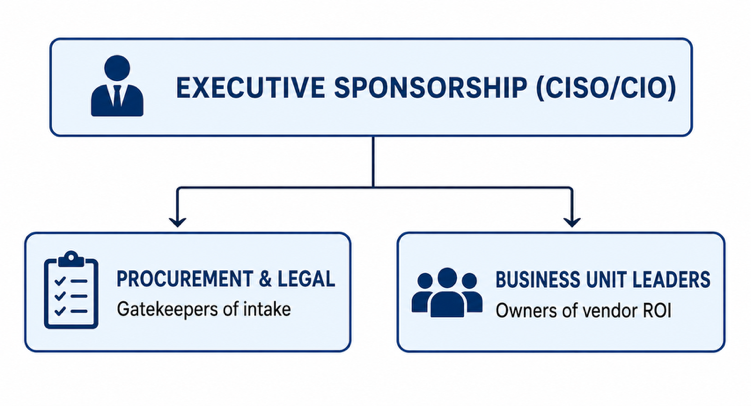
A TPRM program cannot be viewed as purely an IT security problem. Rather, it is an organizational culture challenge. If executive teams and legal teams view TPRM as a bureaucratic bottleneck, they will actively bypass it, leading to shadow IT and unvetted risk.
Aligning TPRM with Business Strategy
Executives are less concerned with the mechanics of vendor assessments and are more focused on understanding how third-party relationships could impact company revenue, brand image and trust, regulatory compliance, and business continuity. To gain support from leadership and the board, TPRM should be framed as an enabler of business resilience, not a cost center or administrative burden. Instead, show the executive team how proactive risk management prevents critical operational interruptions, protects brand equity, and satisfies regulatory requirements that could otherwise halt business expansion. At the same time, it is also supporting growth, innovation, and operational resilience.
Security Awareness
Instilling a security mindset across the organization can seem intimidating. In a recent blog, ISE showcased a 90-day plan for how psychology can be used to help build a security culture within your organization. This plan showcases a clear timeline, along with a checklist highlighting key milestones to guide you in your efforts. To access this plan and learn more about how understanding human behavior will benefit the security awareness culture in your organization, check out the ISE blog.
- Lifecycle Risk Architecture: Managing Remediations and Mitigations
Identifying vulnerabilities, gaps, and non-compliance during an assessment is only half the battle. The true measure of a mature and successful TPRM program is how it tracks, manages, and resolves those identified risks. As mentioned earlier, managing vendor risk via email and spreadsheets is not a plan for success. Information will get lost, deadlines missed, and accountability dissolves. Instead, relying on a TPRM platform that helps you centralize, streamline, and simplify your VRM process will help you in making large-scale business decisions more accurately and confidently.
When a third-party is underdoing an assessment, they will ultimately want to know: ‘what do I have to fix to do business with you?’ Start takes those items of shortcoming that are identified during the assessment and extracts a remediation plan. It is crucial to outline how you wish the third-party to address the items of concern so they can action items quickly and to your standards. Remember that not every facility is the same, so it is important to be proactive and collaborate with your third parties so they too can feel the investment in security changes are worth their while as well. Ecosystems are only as secure as their least secure partner. Taking the time to understand your third-parties limitations may also be an opportunity to help them grow.
Once remediations are addressed, scheduling regular check-ins will help to ensure that your standards continue to be met. Things can change quickly at facilities and those changes are often not communicated and can result in further security issues. By following up with your vendors periodically and asking if anything has changed with their security posture, you can identify if another review is necessary or not.
Next Steps
To put these tips into action, those leading or creating a program should focus on these three immediate, high-impact steps:
- Audit: Establish a definitive and centralized list of every third-party vendor currently utilizing your resources or processing your data. This list may change so have a way for your business stakeholders to communicate changes in vendor usage.
- Define the Tiering Criteria: Determine what constitutes your different level of Tiers for vendors based on data access and operational criticality.
- Deploy a Streamlined Tool: Move away from spreadsheets and invest in a dedicated tool that can automate questionnaires and remediation tracking. Once this has occurred, you can work on your information gathering methods.
These initial steps may seem simple, but they could be the difference between a reactive compliance experience and a proactive risk management program. Once you’ve taken the first steps, your organization will be prepared to pursue building a mature, scalable, and resilient TPRM program that not only satisfies regulatory expectations but also strengthens security, protects critical assets, and enables your team to move forward with confidence. If your team would like to create a TPRM playbook unique to your brand or needs help scaling your operation, reach out to a member of our team to learn about how Start can simplify and streamline your VRM journey.